To teach critical thinking, make students practise it explicitly and often: ask open questions, have them justify claims with evidence, compare viewpoints, and reflect on how they reached their conclusions. Critical thinking does not appear on its own from content lessons; it grows when teachers name the skills and build short, regular routines around them. Below are 12 classroom strategies, each with a 10-minute activity, plus a simple way to assess progress.
What critical thinking means in the classroom
For students, critical thinking means asking good questions, judging whether information is reliable, building reasoned arguments and changing their mind when the evidence warrants it. If you want a fuller definition, start with what critical thinking means and the three levels of critical thinking.
12 strategies to teach critical thinking (with 10-minute activities)
| # | Strategy | 10-minute activity |
|---|---|---|
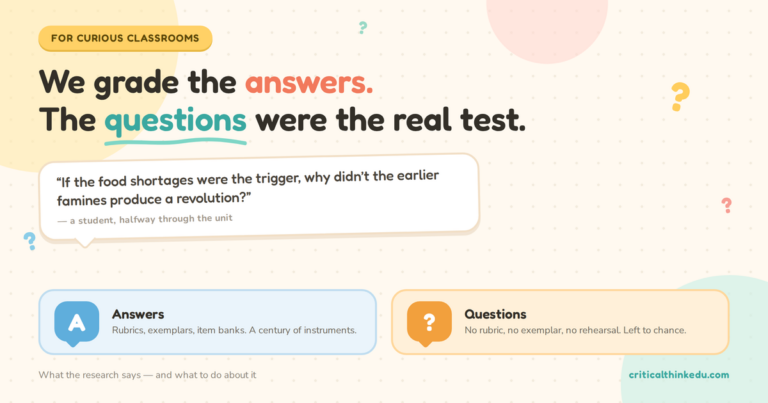
| 1 | Teach students to ask questions | Give a provocative image or headline; students write as many questions as they can in 3 minutes, then pick the best one to investigate |
| 2 | Claim, evidence, reasoning | Students answer a question with one claim, one piece of evidence and one sentence linking them |
| 3 | Fact or opinion? | Sort 10 statements from a news article into fact, opinion and claim-that-needs-checking |
| 4 | Source check | Compare two sources on the same topic: who wrote it, when, why, and what evidence they give |
| 5 | Both sides | Students write the strongest argument for the side they disagree with |
| 6 | Spot the fallacy | Show three flawed ads or arguments; students name what is wrong with each |
| 7 | Think-pair-share with “why?” | After each answer, partners must ask “why do you think that?” twice |
| 8 | Prediction and check | Students predict an outcome, explain their reasoning, then compare with the real result |
| 9 | Logic puzzles | A short grid or deduction puzzle to practise step-by-step reasoning (see our logic problems for 4th graders) |
| 10 | Mini-debate | Pairs argue a simple motion for 2 minutes each, then switch sides |
| 11 | Bias detective | Students find one example of a cognitive bias in a story or in their own week |
| 12 | Exit reflection | Students write: “What did I think at the start? What changed my mind?” (a simple metacognition routine) |
Critical thinking activities by age
| Level | Focus | Example activities |
|---|---|---|
| Primary (ages 6–11) | Questions, patterns, fair reasons | “Would you rather” with reasons, logic puzzles, sorting fact and opinion |
| Middle school (11–14) | Evidence, sources, both sides | Claim-evidence-reasoning, source checks, mini-debates |
| High school (14–18) | Arguments, bias, complex issues | Fallacy hunts, structured debates, research questions, bias analysis |
Teenagers can go further with the high-impact skills to learn as a teenager, and debate is one of the most effective formats at this age: see debate as a critical thinking tool.
How to assess critical thinking
Assess the reasoning, not only the answer. A simple 4-level rubric works for most tasks:
| Criterion | Beginning | Developing | Secure | Advanced |
|---|---|---|---|---|
| Question | Restates the task | Asks a relevant question | Asks a focused, open question | Asks a question that reframes the problem |
| Evidence | No evidence | Some evidence, weakly linked | Relevant evidence clearly linked | Weighs the quality of competing evidence |
| Perspectives | One view only | Mentions another view | Explains another view fairly | Responds to the strongest opposing view |
| Reflection | None | Describes what they did | Explains how their thinking changed | Identifies their own possible bias |
For a deeper look at assessing questioning, read our essay teaching students to ask questions.
Common mistakes when teaching critical thinking
- Assuming it happens on its own: name the skill you are practising (“today we are checking sources”).
- Only rewarding the right answer: praise good reasoning even when the conclusion is wrong.
- One-off lessons: short weekly routines beat a single critical thinking unit.
- Teacher talks, students listen: students should do most of the questioning and arguing.
FAQ: teaching critical thinking
At what age can you start teaching critical thinking?
From the first years of school. Young children can give reasons, ask “how do we know?” and sort fact from opinion. The tasks simply become more complex with age.
How much class time does it take?
Ten minutes, two or three times a week, is enough to build the habit, especially if the activities use the content you are already teaching.
Can parents teach critical thinking at home?
Yes. Asking “why do you think that?”, discussing the news together and playing logic games are simple, effective ways to practise at home.
How does critical thinking relate to AI tools in class?
AI makes it more important. Students should learn to check AI answers against sources, ask what might be missing, and explain the reasoning in their own words.