Fourth grade is when children start connecting ideas rather than just memorizing facts. Logic puzzles harness that shift by asking kids to analyze clues and spot patterns. Brain teasers stimulate cognitive activity and enhance memory, while puzzle play strengthens problem‑solving, spatial reasoning and perseverance. Incorporating logic problems helps 9‑ and 10‑year‑olds develop systematic thinking that supports reading and math.
Key Points: Logic problems are ideal for 4th graders because they strengthen real thinking skills (pattern recognition, focus, deduction, reasoning).
They’re not just “extra activities”: they support confidence, perseverance, and problem-solving habits that transfer into math and reading.
The article highlights multiple types of logic problems (patterns, grids, riddles, sorting/elimination puzzles).
It includes sample problems + solutions to help parents/teachers use them immediately.
It recommends trusted resources (classroom-friendly and home-friendly) for more puzzles and structured practice.
It gives simple integration ideas (daily warm-ups, early finisher work, small groups, weekly logic time).
Why logic problems matter
Solving puzzles isn’t wasted time; it’s a workout for the brain. Teachers we work with in local schools in Ontario and New York find that puzzles give children healthy mental exercise and boost processing speed. The American SPCC reports that puzzles strengthen pattern recognition, focus and resilience. They also help children manage frustration and experience a sense of accomplishment when a solution is found, building emotional regulation and confidence. Brain teasers are about reasoning, not just arithmetic. These benefits make logic problems valuable at school or home.
Types of logic problems
- Riddles and brain teasers: short questions that use misdirection and language play to encourage careful reading and reasoning.
- Number and pattern puzzles: sequences and balance‑scale problems that build algebraic thinking.
- Logic grids: stories with clues that students organize in a table to deduce relationships; the Mind Benders series develops these skills.
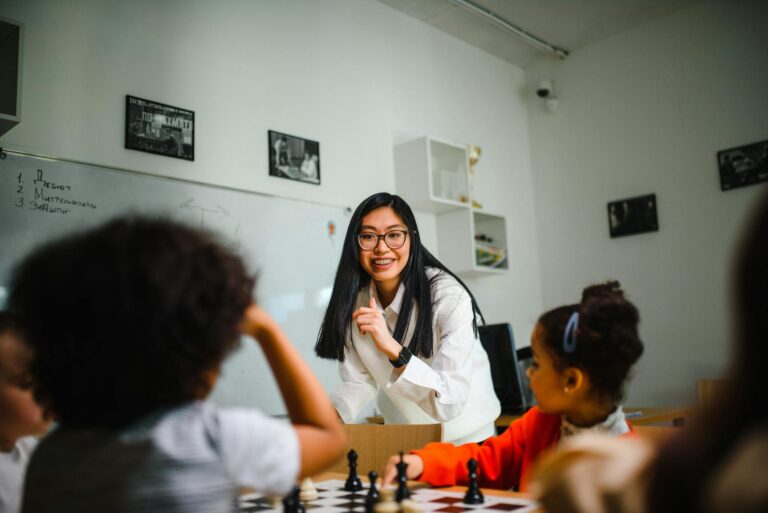
- Spatial puzzles: tangram and board‑game challenges that promote visual reasoning and planning.
Sample puzzle
Three friends—Jamal, Maya and Oliver—each play guitar, flute or drums. Jamal doesn’t play a stringed instrument. The drummer practices next to Maya. Who plays which instrument?
Answer: Jamal plays the flute (the non‑stringed instrument). Maya cannot be the drummer if the drummer is next to her, so she plays guitar. Oliver is the drummer.
Another quick challenge: Anna, Diego and Priya each like apples, bananas or cherries. Anna doesn’t like bananas, and Priya doesn’t like cherries. If Diego likes bananas, who likes what?
Answer: Diego likes bananas. Anna cannot like bananas, so she must like apples. Priya therefore likes cherries.
Resources for parents and teachers
- Big Ideas for Little Scholars: a curated list of puzzle books, card games and free online puzzles for grades 4–5.
- Mind Benders: graded logic grid books that build deduction and reading comprehension.
- Brain‑Teaser Slides (We Are Teachers): free Google slides with riddles that emphasize reasoning over arithmetic.
- Mensa for Kids: free lesson plans and educational games promoting logical reasoning.
- Digital puzzles: apps like PuzzleFree.Game offer easy‑to‑access puzzles for constructive screen time.
- Teacher blogs: newsletters such as JJ Resource Creations share printable puzzles and discuss research on their benefits.
Tips for integrating puzzles
- Start small. Pick manageable puzzles and increase difficulty over time.
- Ask students to explain. Have them tell how they solved a puzzle; this reveals thinking.
- Use as brain breaks. Short riddles can refresh attention and reduce boredom.
- Cross‑curricular. Add puzzles to language arts, math and science to show reasoning applies everywhere.
- Collaborate. Let kids work together; they learn from each other’s strategies.
Conclusion
Logic problems for 4th graders build more than puzzle‑solving skills: they develop patience, reasoning, critical thinking and confidence. Puzzles enhance problem‑solving ability, memory and emotional regulation, and that deduction exercises improve reading comprehension and mental organization. By weaving riddles, pattern puzzles and deduction grids into lessons—and by using the many free and commercial resources available—parents and teachers can nurture children’s natural curiosity.
When students learn to approach problems methodically and celebrate each small insight, they lay a foundation for critical thinking that will serve them throughout school and beyond.
Critical Thinking Education FAQ
The best logic problems for 4th graders are short, clue-based puzzles that require deduction, sorting, and pattern recognition. Grid puzzles, “who owns what” riddles, and number pattern challenges work especially well.
A great goal is 10 minutes, 3–4 times per week. Short sessions are enough to build strong reasoning skills without feeling overwhelming or turning it into “extra homework.”
Yes. Many logic problems rely more on thinking and reasoning than advanced math skills. They help kids slow down, organize information, and build confidence—skills that often improve math performance over time.