Introduction
Critical thinking is one of the most sought-after skills in education, the workplace and daily life. It helps us make better decisions, understand complex issues and avoid being misled by incomplete or biased information. But despite how often the term is used, few people can define it clearly.
This article breaks it down in a simple, practical way.
Critical thinking is a structured way of analyzing information so you can make logical, evidence-based decisions. It includes asking the right questions, evaluating sources, identifying assumptions and reaching justified conclusions. In a world of fast information and AI content, strong critical thinking helps you avoid misinformation, solve problems and communicate clearly. Critical thinking allows students and professionals to separate themselves for competition and reach coveted roles.

What Does “Critical Thinking” Mean?
At its core, critical thinking is the ability to analyze information carefully and make reasoned, evidence-based judgments instead of relying on assumptions, emotions or surface-level impressions.
It is not about being negative, criticizing others or overcomplicating things. It’s about thinking with precision.
A simple way to understand it:
Critical thinking = Asking the right questions + Evaluating evidence + Reaching a justified conclusion
The Formal Definition of Critical Thinking
Across academic fields, the most widely accepted definition is:
Critical thinking is a structured cognitive process involving analysis, evaluation, and reasoning to form well-supported conclusions or decisions.
More expanded definitions include the following elements:
- Analysis: Breaking down information to understand what is being claimed
- Evaluation: Judging the credibility, relevance and strength of evidence
- Inference: Reaching conclusions using logic
- Explanation: Being able to justify your reasoning
- Reflection: Stepping back to reconsider biases, assumptions and alternative perspectives
Together, these skills create a disciplined way of thinking that leads to clearer answers.
Why Critical Thinking Has Concrete Benefits
We live in a world shaped by:
- Information overload
- AI-generated content
- Social media debates
- Conflicting political narratives
- Fast-paced decision-making at work
In this environment, the ability to think critically becomes a superpower.
People who use strong critical thinking:
- Understand complex topics faster
- Make better decisions (personal and professional)
- Detect misinformation and logical fallacies
- Solve problems more creatively
- Communicate ideas with clarity
- Adapt to new situations with confidence
It’s also a cornerstone skill for top performers in law, medicine, science, management, entrepreneurship and public life.
How Critical Thinking Works in Real Life
To better understand the concept, here are simple examples:
1. Reading the News
Instead of accepting information at face value, you ask:
- Who wrote this?
- What sources are used?
- What does the data actually show?
2. Workplace Decisions
Before approving a project, you question:
- What problem are we solving?
- What are the risks?
- What are the alternatives?
3. Academic or Debate Settings
You look for:
- Logical consistency
- Evidence strength
- Counterarguments
- Underlying assumptions
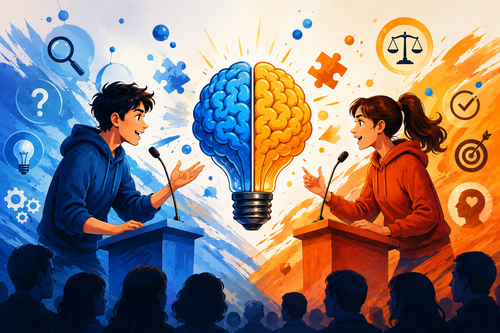
This is why debate is one of the most powerful ways to train critical thinking, it forces you to justify every claim.
Common Misconceptions About Critical Thinking
“It means thinking more.”
Not true — it means thinking better.
“It’s only for intellectuals.”
Every person uses critical thinking daily, whether choosing a school, evaluating job offers, or comparing prices.
“It kills creativity.”
On the contrary, it strengthens creativity by grounding ideas in reality and helping you choose the best ones.
How to Improve Your Critical Thinking (Beginner-Friendly Tips)
You can start building this skill today:
- Ask “Why?” two or three times when hearing any claim
- Look for evidence, not opinions
- Separate emotion from reasoning
- Identify assumptions — yours and others’
- Consider alternative viewpoints
- Practice structured analysis, like in debates
- Pause before concluding
Small, daily habits compound into powerful critical thinking skills.
Final Thoughts
Critical thinking is not a talent, it’s a trainable skill that opens doors in every area of life. It helps you understand the world more accurately, make smarter decisions and communicate with clarity in a noisy, fast-changing environment.
Whether you’re a student, professional, debater or leader, developing this skill will pay off for the rest of your life.
If you want to practice critical thinking, structured formats like one-on-one debates or guided debate platforms offer an easy way to refine your reasoning step by step.
Critical Thinking Education FAQ:
Critical thinking means looking at information carefully instead of accepting it immediately. It involves asking questions, checking evidence, considering different viewpoints and making decisions based on logic rather than emotion or assumptions.
Critical thinking helps people understand complex issues, avoid misinformation, spot biases, solve problems and make better decisions. It improves communication and is essential in school, work and everyday life.
Critical thinking is a skill anyone can learn. It improves with practice through questioning assumptions, analyzing sources, comparing arguments and reflecting on the reasoning behind your choices.